Sunday, March 8, 2020

Pocket Hoops (aka Hip Buckets) and a Green Silk Petticoat

Pocket hoops. Paniers. Side hoops. Hip buckets. What ever you call them, these things are awesome. Like pockets on steroids. You can fit just about anything you need to carry in them. Honestly, I'm slightly surprised these things ever went out of style - because you can carry everything in them, hands-free!


While I was making my robe a la francaise last year, I realized, about a week before my event,
"oh crap! I need skirt supports!" In the 1760's, when my gown would have been in style, this meant pocket hoops.


Making pocket hoops slightly scared me. It sounded complicated. However, I didn't have time to avoid this project (as I've done with other projects), as I really did need pocket hoops to wear to the picnic. So, I started researching.


First I looked at the side hoops in the American Duchess Guide to 18th Century Dressmaking. They looked easy to make, which was reassuring, however they weren't actually pocket hoops, just side hoops. They lacked the back and bottom which allows you to actually, you know, use pocket hoops as pockets. If I was going to make these hip-hoop skirt support thingies, gosh darn, they were going to be able to hold stuff. 


Next I looked in Corsets and Crinolines by Nora Waugh and found a diagram for actual pocket hoops, complete with a back and a bottom. Just what I needed. The pattern didn't look too hard to size up, I'd just have to figure out the easiest way to actually assemble these things.


Before drafting my pattern, I decided to quickly google "How to Make Pocket Hoops" (Or something along those lines, this was nearly a year ago, so I don't remember exactly.), and I discovered the best resource ever!


A couple years ago The Dreamstress hosted a pocket-hoop sew along on her blog. She broke down how to make pocket hoops step-by-step, and even gave dimensions for all the pattern pieces so one would not have to figure out the scale in Corsets and Crinolines. Seriously, these blog posts are the best thing ever for someone needing to make pocket hoops in a hurry!


I followed the instructions and measurements given and quickly made my pattern. Out of my stash came a green striped polished cotton, green cotton tape for boning channels, heavy-duty, extra-long, zip ties for boning, and cotton twill tape for the waist ties.


My pattern pieces were all cut out of the polished cotton, where the boning channels needed to be was marked, and off to the sewing machine I went to sew those boning channels in place.


The pocket hoops were entirely constructed by machine, and before long I was cutting zip ties to the correct length and inserting them into the channels. I put two zip ties in each channel, as I was afraid one wouldn't be enough to support the weight of my gown.


Zip ties in, waist ties on, and my pocket hoops were done! It only took a couple hours one afternoon - much quicker than I'd anticipated! 


They quickly became my new favorite thing. Seriously, you can store anything in these suckers! They make all other pockets look wimpy.


Ok, so perhaps you can't carry a cat in them, because the cat has opinions on that subject, but beyond felines. . .


 You can store rolled up petticoats in these pockets.


This would be the green silk petticoat I made to wear with my gown to the Francaise Dinner with the Saint Louis Georgian Sewing Society 


It was all hand sewn in the week leading up to the dinner. I surprisingly enjoy hand sewing 18th century petticoats.


The green silk taffeta was a birthday gift from my mom a year and a half ago. (Yeah, it took me a while to get around to actually using this fabric). There was just barely enough for a petticoat - and it nearly perfectly matched the green trim on my francaise!


After sewing up the side seams (with a running back stitch in case you're wondering) and hemming the petticoat, I put my pocket hoops on my dress form and carefully pleated the top edge of the petticoat over the hoops so the hem would hang evenly once finished.


The pleating took some trial and error, but it got done.


The pleats were then basted in place (While I was waiting in the school pick-up line for the kids I nanny apparently, judging by the steering wheel in the back ground.) and I finished the waist with linen tape.


Waist tapes on, the petticoat was done - with a couple days to spare even!


Just like with all my other 18th century petticoats, this one is fastened by first tying the back waist tie around the front, and then the front around the back.


It was rather windy the morning we took these pictures, and the taffeta is rather light, so you'll have to forgive me for the lack of a good picture of the finished petticoat. 


I promise you, the hem is actually even, and the green silk petticoat, while a touch shorter than I would prefer, does actually cover my under petticoat completely when the wind isn't being troublesome.


This green silk petticoat was the perfect thing to slightly change the overall look of my francaise for the dinner! I think I prefer it to the matching petticoat I made for this gown.
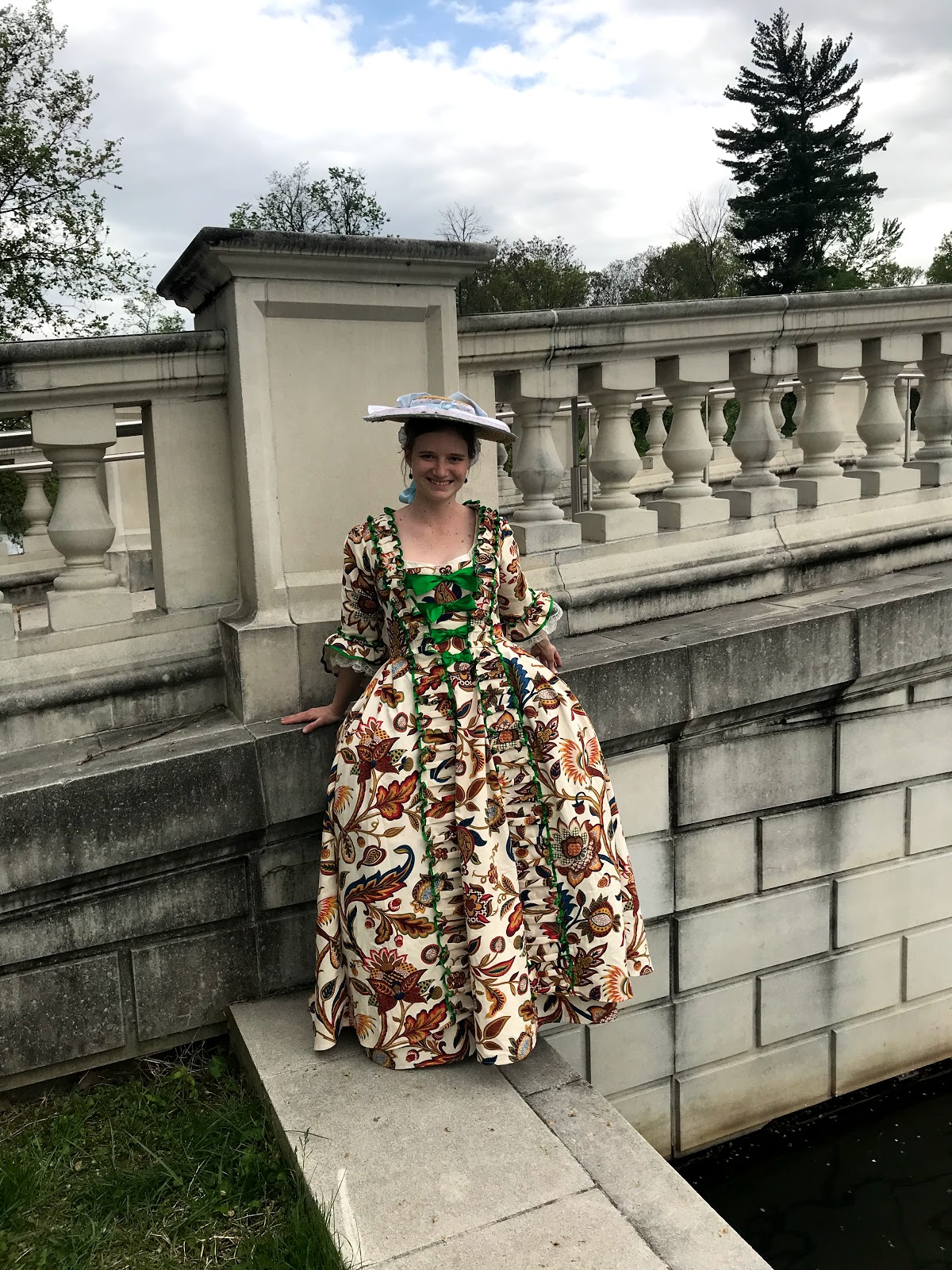

That said, my favorite part of my 1760's ensemble, is definitely the pocket hoops - because you just can't beat huge pockets!


Why did these hip-bucket thingies ever go out of style???

Thursday, March 5, 2020

The Sweater with Leg-of-Mutton Puffed Sleeves

On one of my flights home from Uganda I noticed a woman wearing a sweater with leg-of-mutton sleeves and I was stunned. How had I never thought to make an every day top with sleeves like that?? I love puffed sleeves!!


Now, for those of you wondering, leg-of-mutton sleeves are those which are puffed and very full at the top of the arm, and more fitted below the elbow. Bishop sleeves, on the other hand, are almost opposite, very full at the bottom of the sleeve, rather than the top, before being gathered in a tight cuff. (Here's a couple bishop sleeved tops I made last winter.)


Leg-of-mutton sleeves are the puffed sleeves which were popular in the 1890's - one of my favorite eras of fashion. They are the sleeves loved by Anne Shirley and frowned upon by Marilla for "wasting fabric" in Anne of Green Gables. (That scene in the book made me fall in love with puffed sleeves as a child, and, clearly, I have yet to fall out of love with them.)

  
This leg-of-mutton sleeved sweater on my flight from Brussels to Chicago made me realize I needed a top with similar sleeves in my wardrobe. Thus, within 24 hours of returning home, I had just such a sweater cut out and ready to sew together. (Though it would be the following week before the sweater actually got sewn up as I had to take a break and go to Florida for a cousin's wedding.)


I started with my trusty, tried-and-true, pattern, the Outer Banks Boatneck by Winter Wear Designs. This is, I think, the 12th time I've made this pattern. I've made a couple personal fitting alterations (mostly just adding a bit of width to the shoulders, like I have to do on every pattern.) and it fits me perfectly every time!


As I don't actually like the way bateau necklines look on me (I've altered the neckline shape every time I've made this pattern.) for this shirt I opted to slightly lower the front neckline and give it a bit of a sweetheart shape.


To do this I first cut out my front bodice with the normal bateau neckline, then free-handed my new neckline idea with the rotary cutter and altered the neckline facing to match.


Neckline sorted, it was on to the sleeves - the true eye-catcher of this top. I started by tracing the plain long sleeve included with the Outer Banks pattern.


Next I slashed my traced pattern piece from sleeve head to just above the elbow, where I wanted the fullness of my leg-of-mutton sleeves to end.


I spread the pattern piece apart where it was slashed until I thought it looked like I'd added enough fullness for a decently puffed sleeve.


Then I filled in my sleeve head with scrap paper. I drew in the new sleeve head shape following the underarm curves up at the front and back and adding a bit more height for extra puffiness.


With that my leg-of-mutton sleeve pattern was done and ready to use, it was on to cutting out and sewing up!


 I picked up an incredibly soft cotton rib-knit at a local quilting shop last spring and it seemed like just the fabric for my new sweater. It was a narrower width than most knit fabrics so the 2 yards I had was just barely enough to get the sweater, with it's puffed sleeves, cut out of.


 As I've had disastrous results when attempting to hem rib knit before, I opted to finish the sleeves and hem with bands instead of a traditional hem.


Since this rib-knit had no spandex to keep it from stretching out and loosing shape, I stabilized the seams between the shirt and the bands with fold-over elastic from my stash. (clear elastic is better for this, but I was using what I had on hand.


This sweater took a little longer to make than the Outer Banks Boatneck usually does, due to needing to gather the sleeves into the armscye, but it still went together relatively quickly and easily.


The finished sweater is just what I hoped it would be - soft, comfy, and snugly, with fabulous sleeves!


For pictures I paired it with my gold skinny jeans from 2 years ago, which recently got an update.


The old metal zipper I'd used for the fly gave out, loosing teeth until it didn't work anymore.


I ripped the old zipper out and replaced it with jeans buttons and button holes for a button fly, since that was easier than installing a new zipper would have been. (A new zipper would have required removing the waistband, this didn't.)


With their fancy button fly my gold skinny jeans are back in regular wardrobe rotation, which makes me pretty happy.


Who knew gold skinny jeans would get worn as often as they do?


They pair well with a surprisingly wide variety of tops in my wardrobe, and it's always exciting when a new top can be worn with them.


Such as a soft blue sweater with fabulous puffed sleeves!


Sunday, March 1, 2020

An Exercise in Creativity - an 1830's Witch Bonnet

At some point last fall I decided I wanted a large woolen shawl. So I cut a 60"x 60" square from a gray and red plaid wool and started fringing the edges. I'm still not done fringing that shawl. I've not been very good at sticking with it. I tend to work on it as the fancy strikes me, then set it aside and not touch it for weeks at a time.


Anyway, very early in this shawl-making venture, I decided I wanted to make a matching bonnet from the remainder of the plaid wool. Well, maybe not exactly a bonnet. My first idea was to make a Professor McGonagall plaid deer-stalker type witch hat, like the one I did for a commission last spring. This plan lasted a few days, until I saw the historically-inspired witch bonnet Sarah, of "A Most Peculiar Seamstress" made and posted on Instagram. Suddenly my plans changed. What was left of my plaid wool would become a historical witch bonnet!


My first plan was to make an 1840's inspired witch bonnet, as that's a decade I seem to return to a lot in costuming. Then I decided I wanted to do something different, and a little more dramatic. I would make an 1830's inspired witch bonnet, with a magnificent huge flared brim.

1830's Bonnet, LACMA
I searched out pictures of 1830's bonnets on Pinterest, got a vague idea of what I wanted, and then set to figuring out a pattern.


Even though it's not the shape I was going for at all, I decided to start with the one structured bonnet pattern I had in my stash - McCall's M5129. (This is the pattern I used to make the bonnet to go with my purple plaid wool dress, and before that a bonnet to go with my first Civil War Dress.) As much as I really ought to draft my own patterns from scratch, I'm lazy and prefer to start with a pre-existing pattern, slightly resembling the image in my head and hack it out of recognizable and into whatever the heck I want.


For this particular project, I decided to start with the bonnet brim. 1830's bonnets tend to have large flared brims with rounded edges. So I started with the brim with rounded edges from my pattern. It wasn't flared at all, but I could fix that! I traced the brim pattern onto plain brown paper.


Then I slashed my traced pattern piece from the outer edge of the brim to just above the inner edge of the brim.


I laid this slashed up brim piece on top of more brown paper, folded in half. I lined up the "on the fold" edge of the pattern piece with the fold of the paper, then flared out that brim pattern by spreading apart the slashes at the outer edge of the brim while leaving them connected at the inner edge. This gave me a half-circle-ish shaped brim pattern.


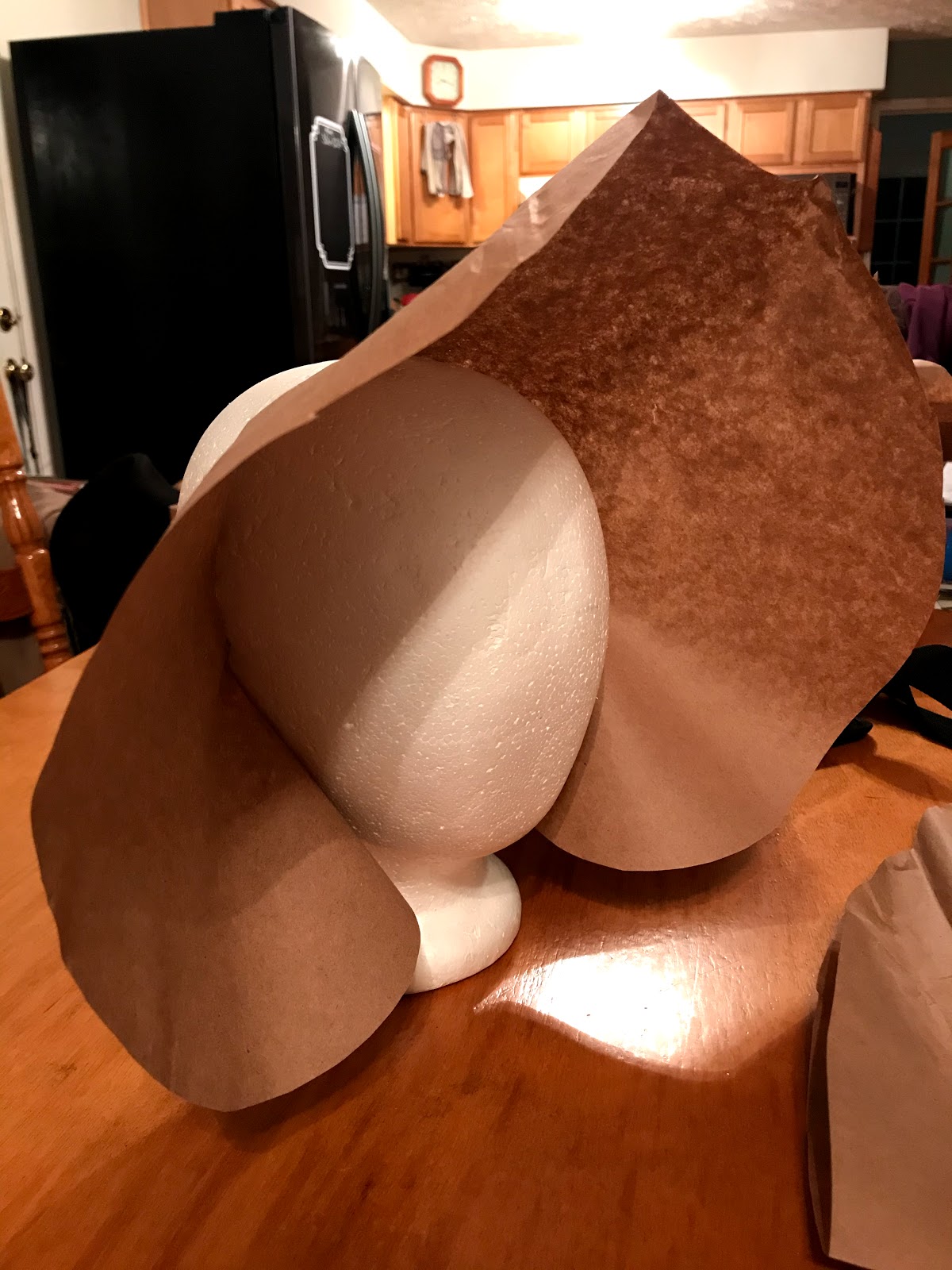
I cut out my new brim pattern, unfolded it, and pinned it to my Styrofoam head to see how it turned out. It was very, very large, and very, very flared. I definitely over did the "large, flared," part of the 1830's bonnet brim description. This "pattern" resembled elephant ears more than it did a bonnet brim.


I removed the pattern from my Styrofoam head, folded it in half again, and cut in down several inches.


I tried my pattern back on the Styrofoam head and was a bit more pleased - my pattern was much closer to resembling the shape I was going for here. It just required a bit of perfecting as it was a bit too flared in some areas and not flared enough in others.


I proceeded to do a bit more slashing and spreading where I wanted more flare.


Followed by slashing and overlapping where I wanted less flare.


Eventually I was quite pleased with the shape of the thing.


I decided I had a brim pattern which would work and moved on to the crown.


For the crown I required no starting pattern. As this was to be a Hogwarts-inspired witch bonnet, the crown just needed to be in the shape of a pointy witch hat. The crown of a witch hat is really just a partial circle, super easy to draft yourself.


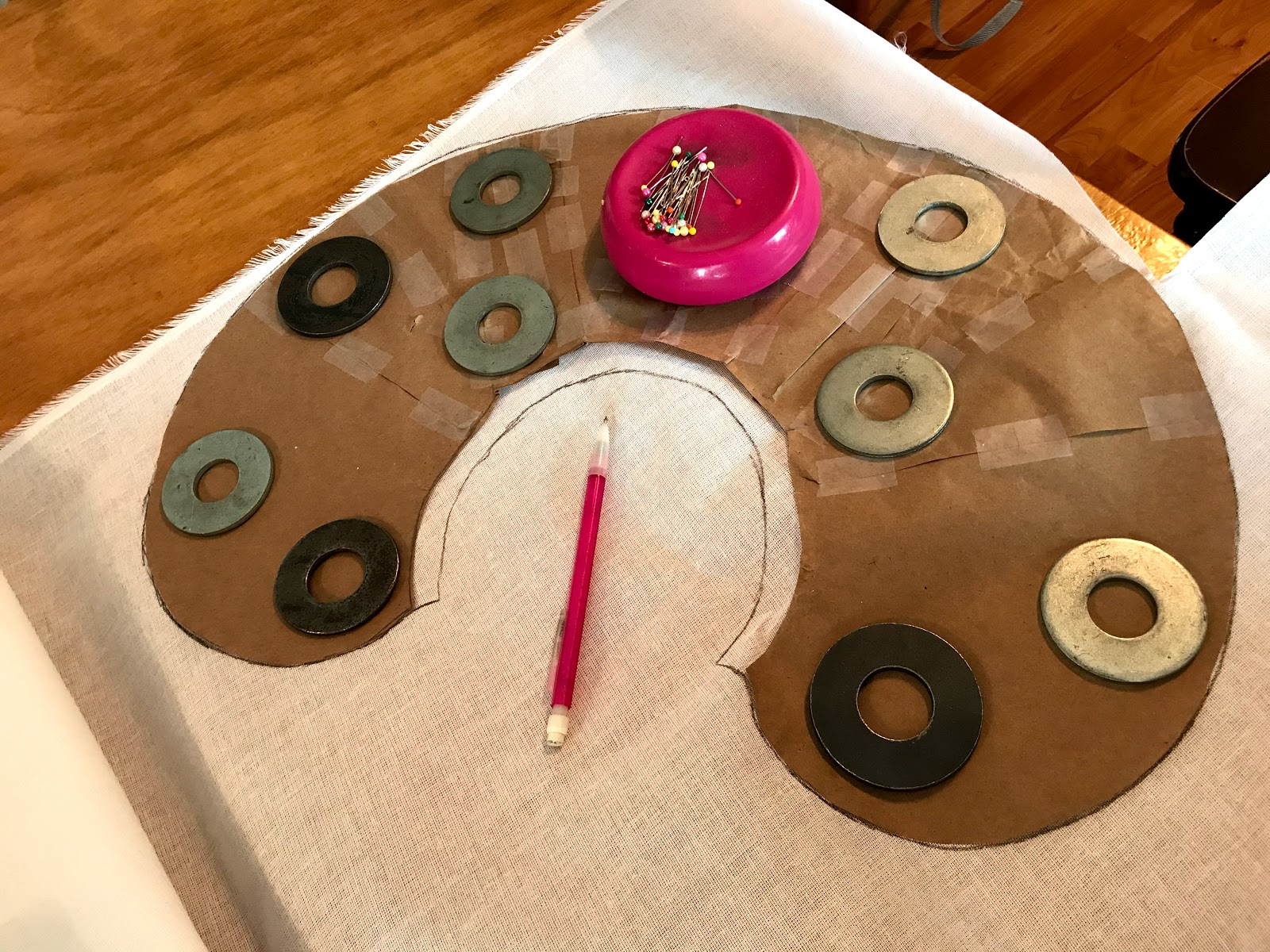
I cut about 3/8ths of a circle out of brown paper, taped together what would be the seam line, and pinned it to the Styrofoam head along with my brim. A touch of finangling and I was satisfied. 


I removed all the brown paper from the head and laid it flat - I had my pattern!


I added seam allowance to each piece and cut it out of buckram and wool. For the lining I used a scrap of silk I'd dyed dark red for a project a year ago. It did not turn out the correct color for piping my 1898 jacket, but it did match the red in my wool plaid quite well, so it was perfect for my bonnet lining! The crown lining was cut in the same shape as the buckram and the wool. The brim lining, however, I cut as a long strip, as wide as the widest part of the brim and as long as the circumference of the outer edge of the brim. 


One edge of the strip of silk was pinned flat to the outer edge of the brim. The other edge was gathered up to fit the inner edge of the brim. 

1830's bonnet, sold by Christie's (I believe, it was hard to find info on this one - but look at that beautiful brim!!)
The effect matches the shirred brim linings I've seen in pictures of 1820's, 30's, and 40's bonnets.


I basted together all the layers of the brim by hand, then did most of the bonnet assembly by machine. I sewed up the back seam of the crown, then sewed the crown to the brim and added a ruffle at the back where the brim ended. The crown lining got slip-stitched in place to cover the seam between the crown and the brim and ruffle.


I bound the outer edge of the brim in bias tape made from scraps of my red silk and added wire to help the brim keep its shape. I used millinery wire harvested from a thrifted hat - and oh my goodness! Millinery wire is amazing!!!! In the past I've used whatever wire I could get my hands on locally for hat and bonnet making, and it's never worked quite right. Always either too bendy or too stiff and hard to shape. Millinery wire though has just the right body for the job, making it a joy to use. Now I need to find a source for it and buy this stuff in bulk!


Once the wire was in and the brim was done the bonnet was structurally done and ready for trimming! I tried it on, and the youngest child I nanny enjoyed taking bonnet selfies with me. (I mostly cropped him out of this picture though, as I avoid posting pictures of other people's kids on the internet.)


I used some black silk dupioni from my stash to make ties. At first I made these a bit too short, so I had to add about 6" of length to each one after I'd attached them to the bonnet. (Yes, I could have removed them and made whole new ties the correct length, but I didn't want to waste fabric.)


For trimmings, I took the left over dupioni from the ties and the scraps of red silk I had left and just played around with them until I wound up with something I liked.


I did my trim configuring and sewing while sitting on the couch and watching the 1994 Little Women movie with my sister. We went and saw the new Little Women movie (in costume!) when it came out in December so it was fun to watch the old movie again and compare the two.


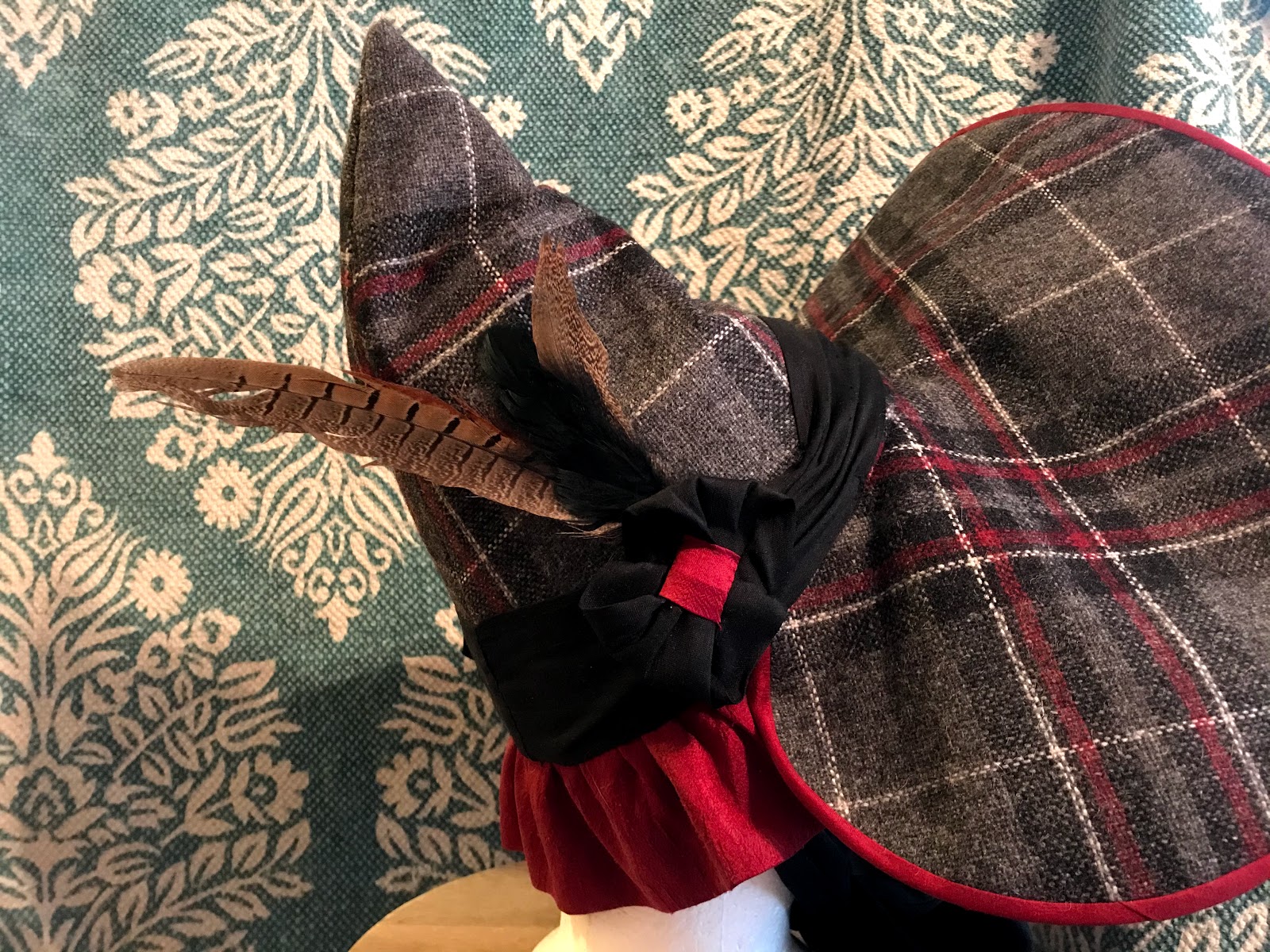
Once the silk trim was on and I was satisfied with it, the final touch was a couple pheasant feathers. You can't have a witch bonnet without feathers!


I am absolutely thrilled with how the bonnet turned out! It's even better than I expected it to be!


 It was a really fun creative project to design and execute. 


A mixture of history and fantasy all my own, in a slightly different medium than I usually work with.


A fabulous project to get me out of my usual "rut", whatever that is.


This exercise in creativity has made me very excited to do more bonnet making - which is good because I really do need more head wear in my historical wardrobe!


Once I finish fringing the matching shawl, I'll take some pictures of the bonnet and shawl actually being worn with one of my historical dresses, but for now I only have a bonnet and cat selfie to leave you with. (The cat remained in my lap the entire time I was trimming the bonnet - I do believe she approves of it!)


I'm now all set for Halloween when it rolls around in 8 months. Perhaps between now and then I can find a couple other excuses to wear my witch bonnet as well, because this thing is too fabulous to only be worn once a year!